
Technical Articles
NANBEI Is Professional On Providing One-step Solution Of Laboratory Instruments And Equipment
Most buyers researching a deep-search metal detector ask the same question first: how does a handheld instrument "see" through more than three meters of soil? The answer lies in three technologies working together — a very-low-frequency (VLF) transmit/receive system, an active ground balance circuit, and a discrimination network that tells the operator what kind of metal is down there before they ever pick up a shovel. The MD-91(4M Underground) Ground Search Metal Detector combines all three, and this article walks through what actually happens inside the unit from the moment it is switched on to the moment it signals a target.
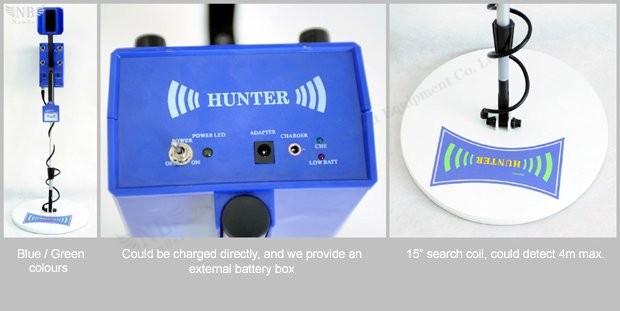
The model name references the detector's rated maximum operating depth for large, highly conductive targets under favorable soil conditions — roughly 4 meters. It's worth being precise here, because depth ratings in this category are frequently exaggerated. Nanbei's own factory test standard buries a 60 cm × 60 cm aluminum plate, 1 cm thick, in dry, low-mineralization soil and records a verified detection depth of up to 3.5 meters with the large search disc attached. That number is the honest baseline: a large flat conductive mass in favorable ground. A coin-sized object, by contrast, is reliably detected at 40–45 centimeters. The relationship is not linear — depth scales with target mass, surface area, and conductivity, not just with detector power. Anyone comparing detectors on "meters of depth" alone should always ask what target size and soil type the number was tested against.
Underneath the housing, the MD-91 operates on a very-low-frequency principle, transmitting at approximately 6.99 kHz ± 0.2 kHz through the search coil. This alternating current generates a magnetic field that propagates into the ground. When that field intersects a metallic object, it induces small eddy currents in the metal, which in turn generate a secondary, weaker magnetic field of their own. The receive winding in the coil picks up this secondary field, and the onboard circuitry amplifies it into an audio tone — reproduced through the built-in speaker or supplied headphones at roughly 450 Hz ± 10 Hz. This is why deep-search detectors like the MD-91 sound noticeably different from a typical handheld security wand: the low operating frequency is specifically chosen because it penetrates soil more efficiently than the higher frequencies used in shallow-target consumer detectors, at some cost to small-object resolution. That trade-off is deliberate — it's the same engineering decision that separates instruments built for archaeology and treasure recovery from those built for airport screening, which is why buyers who need surface-level parcel or baggage inspection are usually better served by a hand held metal detector rather than a ground search unit.
Soil is not electromagnetically neutral. Iron oxides, certain clays, and mineral-rich formations all generate their own background response when a magnetic field passes through them — a phenomenon technicians in this field call the "mineralization reaction." Older, unbalanced detectors cannot distinguish this background mineral noise from an actual metal target, which is why they alarm on rocks, bricks, and mounds of naturally mineralized earth. The practical effect is that older instruments are only reliable for shallow detection, because the deeper you try to probe, the more mineral noise accumulates and drowns out genuine signals.
The MD-91 addresses this with a full-control ground balance circuit. In simple terms, ground balance works by having the operator (or the automatic tracking system) sample the local soil's background response and then electronically subtract it from the received signal, so that only the differential caused by an actual metallic object triggers an alert. Because this balancing is continuous and adjustable, the detector can be re-tuned on site as soil composition changes — moving from a dry field to a riverbank, for example — without needing a different instrument. This is the single biggest factor separating "can only find things a few inches down" detectors from instruments rated for genuine deep-strata work.
A ground balance circuit tells the operator that something metallic is present. A discrimination circuit tells them roughly what kind. The MD-91 analyzes the phase and amplitude characteristics of the returned signal to separate ferrous metal (iron, steel — nails, pipe fittings, scrap) from non-ferrous metal (copper, brass, silver, gold, and most coinage). This matters enormously for fieldwork economics: without discrimination, every dig is a gamble on whether you've found a relic or a rusted bolt. With it, operators can filter out common ferrous trash and prioritize excavation effort on non-ferrous signals, which is typically where higher-value targets — coins, jewelry, cable, and precious-metal deposits — are found.
The MD-91 ships with two interchangeable search heads: a smaller coil for routine work in complex or cluttered soil (better stability, better resolution, better rejection of surface interference) and a larger, waterproof 15-inch disc (390 mm diameter) for maximum-depth searching in relatively uniform ground. The trade-off is straightforward and worth stating plainly rather than glossing over: the large coil reaches deeper but is more susceptible to clutter and requires more uniform soil to perform well; the small coil sacrifices some depth for stability and precision. Field technicians typically start a survey with the small coil to map the general area, then switch to the large coil once they've identified a promising zone with relatively even ground composition.
Two additional controls round out the detection chain. Threshold control lets the operator fine-tune the audio baseline so faint, deep signals aren't masked by background hum — useful when hunting for objects near the outer edge of the unit's depth range. Frequency control allows the operating frequency to be nudged away from ambient electromagnetic interference, which matters in practice near power lines, industrial equipment, or telecommunications infrastructure — a common condition on pipeline right-of-way and urban construction sites.
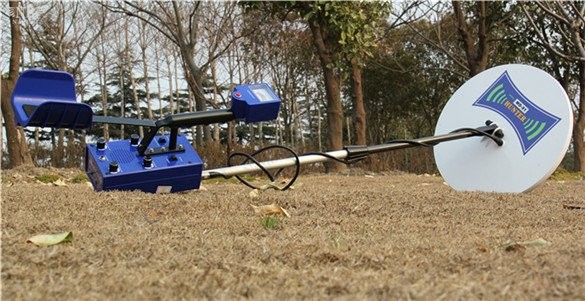
The housing is molded from high-strength ABS engineering plastic, chosen for its combination of light weight, impact resistance, and long service life in field conditions. Power comes from eight 1.5V cells or an optional rechargeable pack, with a DC12V external input available for extended field sessions; the unit includes LED battery-life and charging indicators plus a low-voltage alarm so a session doesn't end unexpectedly mid-survey. On the compliance side, the MD-91 is manufactured under an ISO 9001–certified quality system and carries CE and RoHS marking. For buyers importing into GCC markets, note that GSO (Gulf Standards Organization) conformity assessment is generally required for electronic goods entering the region separately from CE marking, so it's worth confirming G-Mark documentation status with your supplier before shipment. Buyers in ASEAN markets should likewise confirm whether local telecommunications or radio-equipment authorities require type-approval for VLF-emitting equipment, since requirements vary by country even for low-power devices operating well below licensed radio bands.
Because the VLF-plus-ground-balance architecture is depth-oriented rather than speed-oriented, the MD-91 is best suited to applications where finding a target several meters down matters more than scanning large areas quickly: treasure and relic recovery, archaeological survey work, buried pipeline and cable tracing, and pre-excavation utility checks on construction sites. It's a different tool from a screening wand or walk-through detector, and it pairs naturally with other field and geological instrumentation — for example, teams doing subsurface utility or mineral survey work often use it alongside a geological instrument for soil characterization, or a petroleum instrument where pipeline right-of-way work overlaps with hydrocarbon site inspection.
The MD-91's rated depth isn't a single fixed number — it's the outcome of VLF frequency selection, active ground balance tuned to local soil, coil size chosen for the survey stage, and discrimination filtering that keeps operators from digging ferrous trash. Understanding how these systems interact is the difference between treating a "4-meter detector" as a marketing claim and actually getting 3+ meters of usable depth in real soil. For full specifications, coil options, and sourcing details, see the Ground Search Metal Detectors category page, or reach the technical sales team directly for application-specific guidance.